Breaking News
Popular News


Enter your email address below and subscribe to our newsletter
Smart Discovery Store
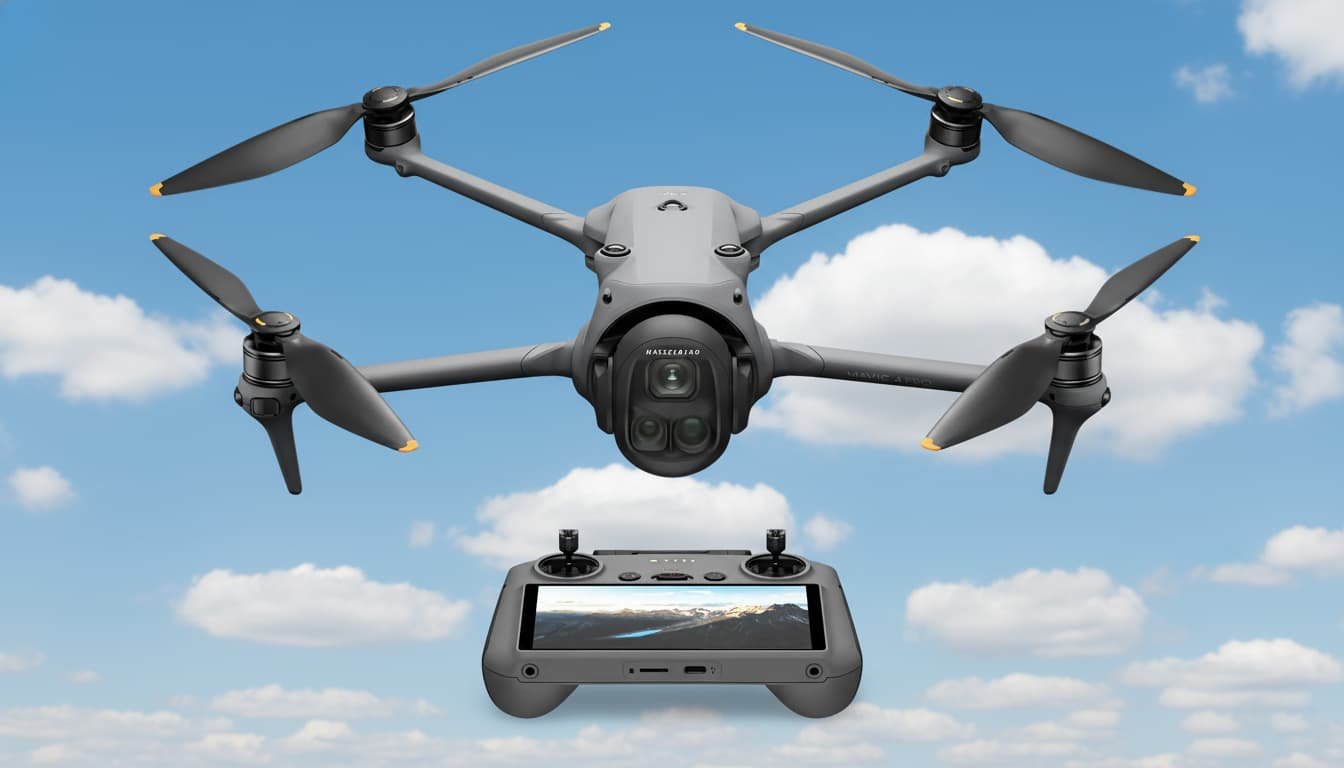
The new DJI Mavic 4 Pro arrives as one of DJI’s biggest generational upgrades in years. After spending weeks flying it across Ireland—capturing real-world footage, testing battery life, checking obstacle avoidance, and pushing all three cameras—I can confidently say this is more than a minor refresh. It’s a full redesign with major improvements in image quality, gimbal mechanics, aerodynamics, flight performance, and controller experience. If you’ve been wondering whether it’s worth upgrading from the Mavic 3 Pro or choosing this as your next premium drone, this breakdown will help you decide.
The Mavic 4 Pro is noticeably bigger and roughly 100 g heavier than the Mavic 3 Pro, yet it remains in the C2 class. The gimbal guard no longer wraps around the back, making it easier to access the battery and microSD card. Internal storage is now built-in even on the base model, and the top-tier Creator Combo includes a huge 512 GB of storage—great for long travel days without swapping cards. The larger propellers might look loud, but they’re actually much quieter thanks to the new aerodynamic body and 19% drag reduction. Combined with the updated propulsion system, the drone feels more agile and stable in the air. Top speed jumps to 25 m/s (or 27 m/s with tailwind), and wind resistance remains extremely strong at up to 12 m/s.
Battery size increases, giving a rated flight time of 51 minutes. Realistically, expect around 38–40 minutes, which is still a big upgrade from the Mavic 3 Pro’s typical 30–32 minutes. The new 240 W charging hub in the Creator Combo is a huge quality-of-life feature. It charges all three batteries simultaneously in 90 minutes—less than half the time needed with the older hub. The new hub also locks the batteries into place instead of relying on a bottom connection, which makes it more secure during transport.
The standout feature of the Mavic 4 Pro is its camera system—three upgraded lenses inside a futuristic spherical gimbal. The main 4/3 sensor is refreshed with better processing, dual native ISO fusion, and a redesigned lens with a wide f/2 aperture. Resolution jumps to 6K 60 HDR, up from 5.1K 50, and fine detail noticeably improves. Dual native ISO fusion allows the drone to blend ISO 100 and 400 simultaneously for a stunning dynamic range of around 16 stops—far higher than the Mavic 3 Pro’s 12.8 stops. The 100 MP RAW/JPEG photos are extremely detailed, even if slightly oversharpened out of camera. The field of view is now 28 mm equivalent, slightly tighter than the previous 24 mm.
The 2.5x camera uses the same sensor size but benefits from the new processing pipeline. Noise is reduced, details look cleaner, and overall color consistency is much better compared to the Mavic 3 Pro. You still get 48 MP photos and strong 4K 60 HDR video quality.
The biggest leap is in the 6x telephoto camera. DJI replaces the smaller 1/2″ sensor with a much larger 1/1.5″ sensor, dramatically increasing detail, reducing noise, improving sharpness, and bringing image quality much closer to the other two cameras. Dynamic range rises to 13 stops, and low-light performance improves as well. Photo resolution jumps from 12 MP to 50 MP, making the telephoto lens a genuinely useful tool instead of a niche extra. This finally makes the triple-camera system balanced and professional-grade.
All three cameras now support 10-bit Normal, D-Log, D-Log M, and HLG—something previously limited on the older model. Slow motion options expand as well:
– Main & Medium Tele: 4K 120fps
– 6x Tele: 4K 100fps
The new spherical gimbal is a major engineering step. It auto-calibrates with wild motion when powered on, but more importantly, it unlocks new shooting angles. True vertical 6K recording is now possible, and the DJI RC Pro 2 controller automatically rotates the gimbal when you rotate the screen. The limitation: vertical mode restricts tilt to about ±9°, meaning you can’t angle the camera down for top-down vertical shots. In horizontal mode, tilt range expands dramatically, including a huge 70° upward angle—great for flying under structures. The 440° roll capability enables in-flight spin shots, available manually or via the new Rotate QuickShot mode. Spin effects can also be used in hyperlapses or waypoint missions.
The Mavic 4 Pro uses redesigned fisheye sensors with higher resolution and better depth perception. It can detect obstacles as small as 2 cm in diameter—better than the Mavic 3 Pro, though still limited against fine branches. Low-light obstacle avoidance is massively improved. Vision sensors work down to 0.1 lux (full moon brightness), and when it gets even darker, the forward-facing LiDAR sensor activates. LiDAR also maps the environment during flight, allowing the drone to execute return-to-home even with weak or no GPS signal.
Dynamic Homepoint returns—something missing for years. When using the DJI RC Pro 2, the homepoint updates automatically to your current controller position. This is a huge safety upgrade for tracking shots and moving locations.
The Mavic 4 Pro adopts the same ActiveTrack 360 system from the Mini 4 Pro and Air 3. It detects subjects at longer ranges, tracks more intelligently, and uses direction-of-travel prediction to plan smoother paths. Maximum tracking speed is around 18 m/s, so extremely fast subjects may outrun it. ActiveTrack works with the main and 2.5x cameras; Spotlight mode works on all three.
DJI’s latest O4+ transmission doubles the Mavic 3 Pro’s usable range:
– 30 km FCC
– 15 km CE
It also supports 10-bit HDR live preview on the controller.
The new RC Pro 2 is one of the best drone controllers ever released:
– Massive 7″ miniLED screen
– 2000-nit brightness
– Foldable design with auto-raising joysticks
– Vertical rotation for vertical video
– New control dial for aperture/ISO/shutter
– Built-in microphone for screen recording
– HDMI output
– 4-hour battery life
It completely transforms the flying experience.
The DJI Mavic 4 Pro delivers major improvements: a vastly better triple-camera system, stronger battery life, quieter and faster flight performance, upgraded obstacle avoidance, and a next-gen controller experience. For Mavic 3 Pro owners, this is a significant and worthwhile jump—especially if image quality, low-light performance, and telephoto detail matter to you.