Breaking News


Popular News




Enter your email address below and subscribe to our newsletter
Smart Discovery Store
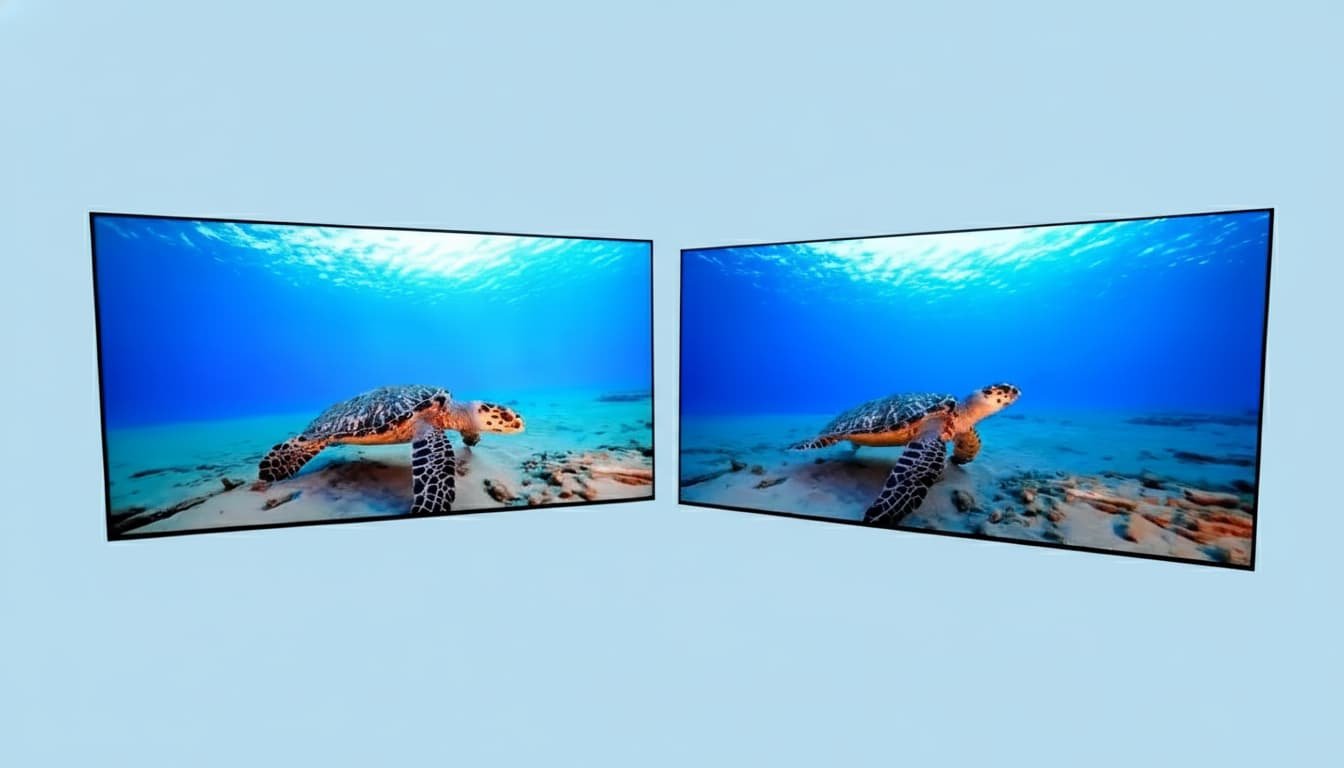
Most TV advice online assumes you watch movies in a perfectly dark room, sitting still, optimizing picture quality like a lab test. But almost nobody lives that way. Real homes have sunlight blasting through windows, kids leaving every light on, and TV sessions that mix movies, sports, and gaming. So, I tested a $3,500 OLED against a $1,600 Mini-LED in real-world conditions over several weeks — movie nights, bright daytime sports, gaming, and everyday mixed use. The results were not what typical “OLED is always better” advice would suggest. And after visiting IFA in Berlin and seeing next-generation display tech, the TV landscape is about to shift even more.
For years the rule was simple:
OLED = perfect blacks
Mini-LED = brightness and value
But the newest flagship OLEDs — LG G5 and Samsung S95 — now reach 2200–2500 nits, a huge leap from older panels. I had the G5 running in broad daylight with sunlight pouring in and overhead kitchen lights on, and the picture still looked fantastic. Historically, OLED brightness collapsed in bright rooms. That weakness isn’t gone, but it’s smaller than ever.
Mini-LED still wins the brightness war. Sets like the Sony Bravia 9 or Hisense U8QG can hit 3000–5000 nits, which matters a lot if your living room is bright during the day. Afternoon sports, animated shows, and casual viewing all benefit from those extra lumens.
In total darkness, OLED is unbeatable. Pixel-level black means dark scenes in films like Dune look cleaner, deeper, and more uniform. You don’t get blooming or halo effects.
But in real rooms — sunlight, lamps, mixed lighting — that advantage shrinks dramatically. Mini-LED blacks have improved so much that blooming is almost invisible during normal viewing. Yes, the most expensive OLED panels still win in dark environments, but in bright rooms? Mini-LED pulls ahead.
OLED does still offer perfect viewing angles, which matters if you have a wide couch and people sitting far off-center. Mini-LED off-axis performance is better than older LCDs but still not at OLED’s level.
Competitive gamers still lean OLED because of instant pixel response times. Motion clarity is unmatched. But for nearly everyone else, Mini-LED keeps getting better:
Modern OLED burn-in risk is small, but if you keep static HUD elements on screen for hours or play one game for months, Mini-LED eliminates the worry entirely. For casual gaming, Mini-LED might actually be the smarter buy.
A good 65-inch Mini-LED ranges from $1400–$1900.
A 65-inch OLED with similar performance jumps to $2200+.
Scale up to 77″ or 83″ and the difference grows even more. If you want a large screen without spending heavily, Mini-LED is far better value while still offering excellent performance.
At IFA in Berlin, one technology stopped me in my tracks: RGB Mini-LED. Unlike today’s LEDs, which use a blue backlight filtered into colors, RGB Mini-LED uses actual red, green, and blue LEDs as the light source. The result:
Samsung, Hisense, TCL, and Sony are all working on versions. It’s extremely expensive today, but within one or two years, this tech will trickle down and could merge the best of OLED and Mini-LED into one category.
Top picks: LG G5, Samsung S95F, Sony Bravia 8 Mark II.
Top picks: Sony Bravia 9, Samsung QN90F, Hisense U8QG.
If you game casually → Mini-LED for brightness + no burn-in concerns.
The expensive OLED didn’t beat the cheaper Mini-LED in most real-world situations. Unless you primarily watch movies in a dark, optimized room, Mini-LED is actually the better fit for modern homes. OLED remains elite — especially for movies — but the idea that it’s always the best choice is outdated.
Mini-LED has caught up fast.
RGB Mini-LED is coming.
And for most people, in most rooms, watching most content, Mini-LED delivers the best mix of brightness, value, and everyday performance.