Breaking News


Popular News




Enter your email address below and subscribe to our newsletter
Smart Discovery Store

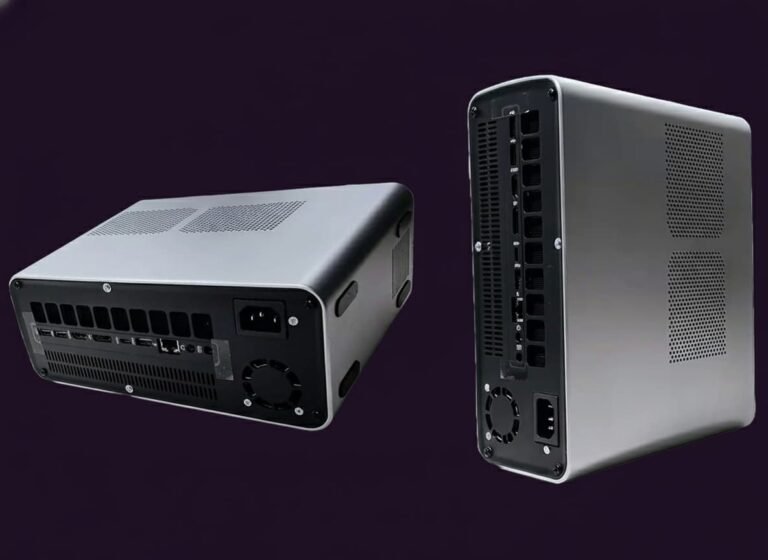
The 2025 ROG NUC 15 enters the mini-PC segment with an unusually high level of performance for its size. Measuring under three liters, the system delivers desktop-grade CPU power paired with NVIDIA’s latest mobile GPUs, allowing modern AAA titles to run at high settings and resolutions. Multiple configuration options are available, including models scaled up to an RTX 5090 laptop GPU, making the device adaptable to a wide range of performance needs.
Despite the compact enclosure, the system includes dual M.2 slots—one PCIe 4.0 and one PCIe 5.0—supporting high-speed SSDs. ASUS has also re-engineered the internal cooling system, targeting improved thermal stability and reduced acoustic output under load.
The package includes a 330-watt power supply, providing substantial overhead for high-performance operation. Connectivity is equally impressive, with extensive front and rear I/O that rivals larger desktop machines.
Despite its small volume, the ROG NUC 15 offers an exceptionally well-equipped I/O layout. The front panel includes two full-size USB 3.2 ports, a USB-C 3.2 Gen 2 port, and a 3.5 mm audio jack for quick-access peripherals. The rear I/O expands this significantly with dual HDMI 2.1 ports, dual DisplayPort 2.1 outputs, a Thunderbolt 4 port with 40 Gbps bandwidth, 2.5 Gb Ethernet, and four additional USB 3.2 Gen 2 ports.
This range of outputs enables multi-monitor setups, VR headsets, and high-speed external storage without requiring adapters. It gives the mini PC capabilities typically reserved for full-size desktops.
ASUS continues its move toward tool-less design with this generation. A rear thumb screw releases the side panel, giving immediate access to the memory and storage bays. Inside, the system ships with 32 GB of SO-DIMM memory but supports expansion up to 48 GB at 6400 MHz.
The dual-slot M.2 array supports one PCIe 5.0 SSD and one PCIe 4.0 SSD, enabling a combined total of up to 4 TB of internal storage. RGB lighting elements integrated into the chassis remain subtle and can be customized in Armoury Crate.
The model tested features the Intel Core Ultra 9 275HX processor—a 24-core, 24-thread unit with 36 MB of cache. It includes eight high-performance cores reaching up to 5.4 GHz and 16 efficiency cores clocking up to 4.6 GHz.
Graphics are handled by the NVIDIA GeForce RTX 5070 Ti (laptop variant), with 12 GB of VRAM, a 115-watt base TGP, and a 25-watt dynamic boost headroom. Users can select higher GPU variants up to the RTX 5090 depending on configuration.
With Wi-Fi 7, Bluetooth 5.4, and Windows 11 preinstalled, the system is designed for modern connectivity demands.
Armoury Crate provides multiple operational modes—Silent, Performance, Turbo, and Manual. Turbo mode is the default for gaming, offering a strong balance of acoustics and power. Manual mode enables extensive tuning, including custom fan curves and GPU overclock adjustments.
The CPU has a configurable power limit up to 170 watts depending on thermal conditions. The GPU supports a TGP range of 100–115 watts with optional dynamic boost and up to +300 MHz clock offsets for advanced users.
Testing the ROG NUC 15 in Turbo mode produced high scores across standard benchmark suites. Geekbench 6 delivered strong single-core and multi-core results, surpassing many high-end processors in both categories. Cinebench R24 further confirmed its capability, posting exceptional multi-core performance for a system of this size.
On the graphics side, 3DMark Steel Nomad scored 3,944 with 39.45 FPS in the graphics section, and 3DMark Time Spy reached 16,990 overall with a 17,625 graphics score—impressive results for a compact desktop powered by a laptop GPU.
The system handles modern AAA titles at high settings with ease:
Cyberpunk 2077 (1440p Ultra, no DLSS):
Averages around 77 FPS natively.
With Frame Generation alone, performance exceeds 220 FPS.
Hogwarts Legacy (1440p Ultra, DLSS Quality):
Averages 78 FPS, maintaining stability even in dense environments.
Marvel Rivals (1440p Ultra, DLSS Quality):
Performance is solid, though competitive players may opt for 1080p, where it reaches 127 FPS.
Horizon Zero Dawn Remastered (1440p, DLSS Quality):
Averages 83 FPS without requiring Frame Generation.
Doom: The Dark Ages (1440p Ultra, DLSS Quality):
Runs above 90 FPS consistently, with minimal thermal fluctuation.
Across all titles, the system remains responsive, fluid, and capable of delivering high-refresh gameplay without thermal throttling.
Compact gaming PCs often struggle with heat dissipation, but the redesigned cooling system performs well. In Turbo mode:
CPU Temperatures:
Average 77°C in gaming, peaking at 93°C during sustained Cinebench R24 workloads.
GPU Temperatures:
Average 67°C under gaming loads, with a maximum recorded value of 72°C.
These results remain well within safe operating limits, and fan noise stays noticeably lower than many laptop systems using comparable hardware.
The 2025 ROG NUC 15 is positioned as a premium small-form gaming desktop, with prices ranging from approximately $1,800 to $2,700 depending on GPU configuration. While not a budget device, the combination of performance, size, and build quality places it in a category that traditional DIY builds cannot easily replicate under three liters.
Its compact enclosure, powerful hardware, PCIe 5.0 support, toolless upgrades, and robust thermal design make it an appealing choice for gamers and creators seeking desktop-class performance without a full tower.
For users prioritizing ultra-small form factor, portability, and high-end frame rates, the ROG NUC 15 stands out as one of the most capable mini PCs available today.