Breaking News
Popular News



Enter your email address below and subscribe to our newsletter
Smart Discovery Store
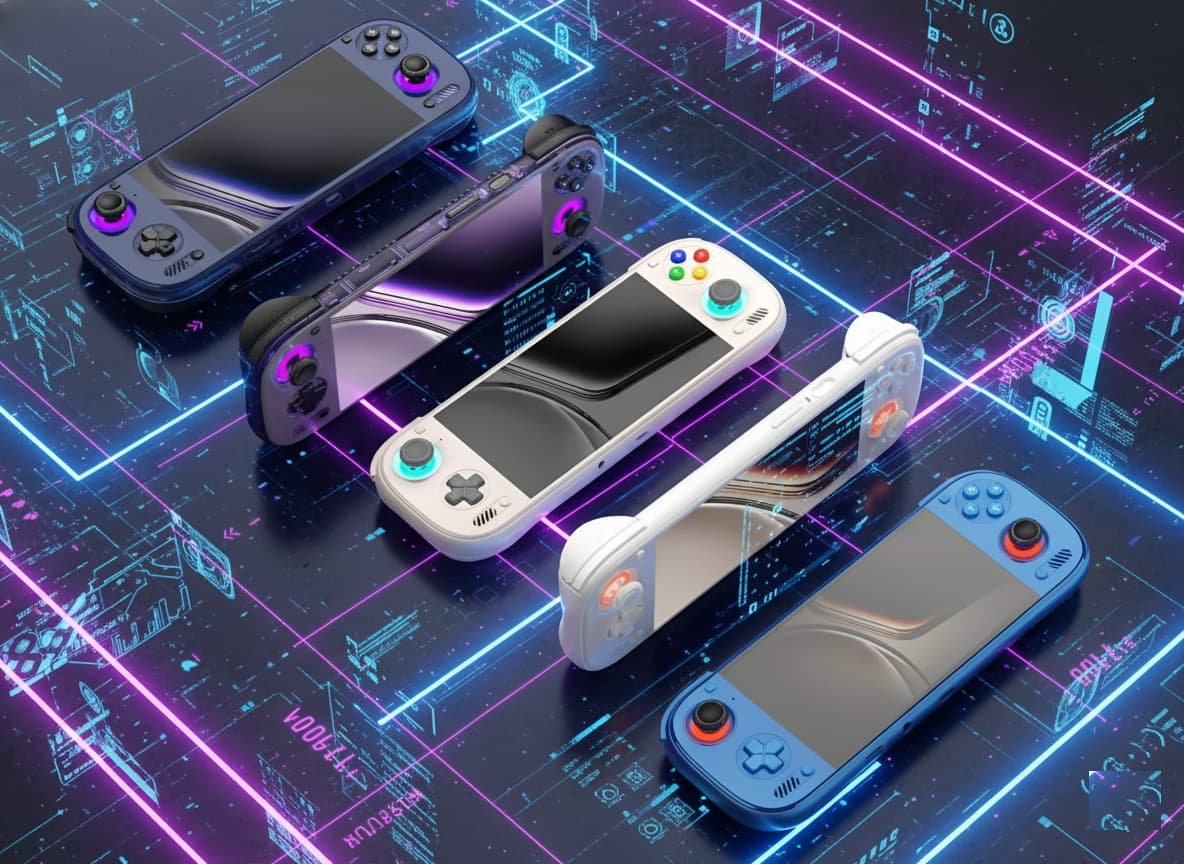
The AYN Odin 3 arrives as a major leap forward for Android gaming handhelds, built around Qualcomm’s Snapdragon 8 Elite chipset—hardware previously unused in a dedicated portable console. This upgrade transforms the Odin lineup by delivering the strongest ARM-based performance currently available in handheld form. The device also introduces a refined hardware package, including a 6-inch 120 Hz OLED display, full-size Hall-effect analog sticks, improved ergonomics, and multiple high-end configurations reaching up to 24 GB of RAM and 1 TB of internal storage.
The unit weighs just 390 grams and runs Android 15 with OTA support. Multiple color variants—including black, white, clear blue, clear purple, and a rainbow-button model—offer a level of personalization not often seen in this category. The clear variants highlight the internal cooling system, which is essential for pushing the Snapdragon platform to its limits.
The Snapdragon 8 Elite is the centerpiece of the Odin 3, featuring two Orion L cores clocking up to 4.32 GHz, six Orion M cores up to 3.53 GHz, and an Adreno 830 GPU capable of 1.1 GHz. Combined with the OLED display’s 120 Hz refresh rate, the chip enables top-tier performance across Android games, emulators, and even x86 PC game emulation through tools such as GameHub.
AYN offers four configurations:
All models support microSD expansion, making storage limits far more flexible for large ROM libraries, Android titles, and PC game files.
Benchmark results highlight the generational jump:
The uplift spans CPU, GPU, memory, and UX, with CPU scoring exceeding one million points alone—an exceptional result for an ARM handheld.
The Odin 3 uses a 6-inch 1920×1080 OLED panel with 120 Hz refresh rate, 152% sRGB coverage, deep contrast, and up to 650 nits of brightness. Visuals appear vibrant and oversaturated in the best OLED tradition, giving modern Android games and classic emulated titles a striking appearance.
Connectivity and charging options include:
The internal 8,000 mAh battery supports extended gaming sessions, while quiet, balanced, and sport performance modes let users choose between efficiency and maximum output.
AYN maintains the familiar Odin silhouette but improves the contouring, grip texture, and button quality. Full-size analog sticks replace the smaller Switch-style designs seen on earlier handhelds, delivering better precision and durability. Linear triggers allow full-range control, especially valuable in racing and shooting games. Two programmable rear buttons provide extra customizable inputs.
The D-pad uses dome switches and offers strong directional accuracy with smooth rolling motions, suitable for fighters and platformers. Front-facing buttons include home and back keys for Android navigation, while a side-mounted power button integrates a fingerprint sensor.
Despite the hardware enhancements, the device remains slim and comfortable, striking a balance between portability and performance.
Running Android 15, the Odin 3 provides full Google Play access, supporting thousands of native Android games, streaming platforms, and third-party launchers. The built-in Odin launcher offers a simplified experience, while many users may prefer traditional AOSP or custom launchers available through the Play Store.
Swiping from the right during gameplay reveals an integrated performance menu with:
Swiping from the top gives immediate access to performance profiles and manual fan controls. The fan reaches noticeable volume at 100%, but remains far quieter than x86 handhelds under similar load.
The Odin 3’s Snapdragon 8 Elite pushes handheld emulation noticeably forward. Dreamcast, PlayStation 2, and GameCube titles—all traditionally demanding workloads—run with elevated internal resolutions and smooth frame pacing.
Dreamcast (Redream):
Marvel vs. Capcom 2 demonstrates precise D-pad control and smooth combat animation.
PlayStation 2 (NetherSX2):
Most titles run comfortably at 3×–4× resolution using the OpenGL backend, delivering sharp visuals that exceed the handheld’s native resolution.
GameCube (Dolphin / equivalents):
4× resolution serves as the optimal setting for most games, with lighter titles scaling up to 5×. Wind Waker, Metroid Prime, and racing titles maintain 60 FPS with minimal dips.
These performance levels reflect a substantial generational advancement over Snapdragon 8 Gen 2 handhelds.
The device can emulate select PC titles directly on Android—no cloud gaming, no remote streaming, and no external PC required. Tools like GameHub allow x86 games to run locally. While performance varies by title, older AAA releases and many indie games reach 40–55 FPS depending on scene complexity and optimization.
This capability highlights how far ARM-based x86 translation has progressed. While not a replacement for true x86 hardware, the Odin 3 opens new possibilities for portable PC gameplay in an Android ecosystem.
The Odin 3 represents a substantial shift in ARM handheld power, design quality, and software flexibility. Its OLED display, expanded RAM options, Snapdragon 8 Elite performance, accurate controls, and extensive connectivity place it at the top of the Android handheld market. Emulation strength, 120 Hz gaming, and rapidly improving PC emulation broaden its capabilities far beyond casual mobile gaming.
Across design, benchmarks, ergonomics, and real-world performance, the Odin 3 establishes itself as the most advanced ARM gaming handheld available today, setting a new standard for the category.