Breaking News
Popular News


Enter your email address below and subscribe to our newsletter
Smart Discovery Store
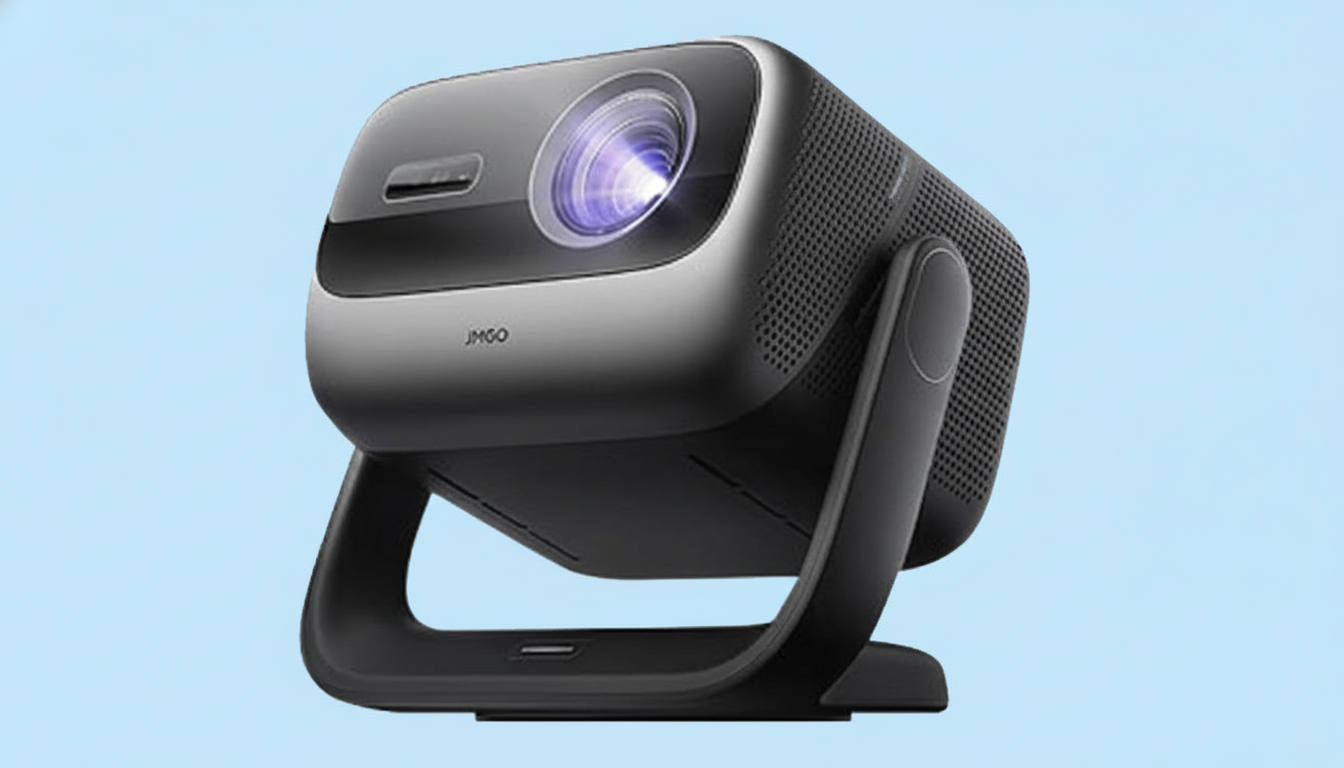
The JMGO N3 enters the market as a long-throw 4K triple-laser projector built on the company’s signature gimbal platform. JMGO already earned attention with the N1 Ultra, a model known for its reliability and high-precision auto-alignment. The N3 continues that philosophy but lowers the price into a far more accessible category. Instead of targeting premium buyers chasing flagship displays, JMGO aims at users who want cinematic scale, clean design, and modern laser technology without crossing luxury-level budgets. The N3’s off-white finish, balanced proportions, and compact motorized stand give it the look of a lifestyle product—something that blends into living rooms rather than feeling like an industrial projector. Despite the friendly design, the projector carries serious hardware: a MALC triple-laser engine, optical zoom, Google TV, auto keystone, and refined geometry correction. It is a device built to deliver real large-screen immersion while staying easy enough for casual use.
The projector ships inside JMGO’s reinforced carrying case, a design choice that instantly communicates portability and durability. The case is structured to protect the gimbal, lenses, and base during travel—ideal for users who move the projector between rooms or take it to outdoor movie nights. Inside the box, the contents are minimal but thoughtfully arranged: a power brick, documentation packet, and a remote with simple navigation keys and shortcuts. The remote does not include backlighting, but the layout remains intuitive enough for dark-room use. The projector itself extends JMGO’s gimbal tradition with an updated mount that rotates smoothly and holds position without wobble. Ports sit on the stationary base, including HDMI (with eARC), USB, and headphone output, keeping cables stable while the projector head moves freely. This approach reduces tugging, drifting, or angle misalignment—issues common with projectors that place ports on the rotating top assembly. Dual 10-watt speakers are built into the structure, offering a functional but modest audio experience ideal for smaller rooms or casual use. However, thanks to HDMI eARC, users with full home-theater setups can route sound to a receiver or high-end soundbar instantly.
Initial setup is simple: position the projector, connect HDMI, power the unit, and activate Google TV. The system detects the screen immediately and begins geometric calibration. JMGO’s strong reputation for auto screen alignment appears again here. The N3’s AI correction locks onto the boundaries of a projection screen in seconds, reframing and skewing the image with impressive accuracy. While many projectors require mechanical adjustments or tedious manual keystone intervention, the N3 snaps the image into shape with minimal user effort. This is the first JMGO long-throw model with a 1.0–1.3x optical zoom, allowing installation flexibility without sacrificing brightness or clarity. Whether the screen is far away or closer than expected, the zoom gives users room to fine-tune the image without physically shifting the projector.
Google TV forms the backbone of the user interface. The layout surfaces recently watched content, recommended titles, trending videos, free channels, and app shortcuts with minimal friction. It avoids heavy advertising clutter, keeps navigation fluid, and organizes media libraries in a unified way that traditional Android TV often struggles to achieve. Google TV Free Play adds streaming channels that act like cable alternatives, offering live content without subscriptions, ideal for casual background watching. HDMI-CEC control integration is smooth: adjusting projector volume automatically adjusts connected receivers through eARC, giving the remote direct control over sound systems without configuration headaches. For users who value simplicity alongside performance, these small conveniences can be as impactful as raw brightness or color accuracy.
The heart of the N3 is JMGO’s MALC triple-laser optical system. This engine uses a nine-chip RGB laser module designed for higher efficiency, stable temperature control, and compact design—crucial advantages for maintaining uniform brightness over long viewing sessions. The quad-layer light diffuser with 400 micro-partitions spreads the laser output evenly to eliminate corner dimming and maintain over 95% brightness uniformity. Dynamic speckle reduction softens grain patterns that often plague laser projectors, reducing visible speckling by up to 97% and giving the picture smoother gradients and cleaner textures. These engineering decisions combine to create a fully balanced 4K image with impressive accuracy: deep contrast, vibrant saturation, and 110% BT.2020 color coverage. On a large 132-inch screen, movies display with cinema-scale presence but without the blooming or inconsistency seen on some LCD TVs at large sizes.
Sports content highlights the projector’s motion clarity and color vibrancy. Fast camera pans retain strong sharpness, while the laser engine’s wide color gamut fills stadiums with rich greens and saturated uniforms. Even though long-throw projectors often struggle with ambient light, the N3 performs well in dim environments. Brightness reaches 1,800 ISO lumens—a meaningful measurement rather than inflated ANSI equivalents—making it suitable for nighttime viewing or controlled-light living rooms. Animated content plays to the projector’s strengths even more. Smooth gradients, precise outlines, and full-range color reproduction give family movies remarkable pop on large screens. The uniformity of MALC laser output ensures there are no dark zones or uneven brightness patches, preserving the visual consistency that animated films rely on.
For dramatic movies, shadow details remain clear when the room is dark. Users sensitive to motion interpolation can adjust smoothing levels or disable the effect entirely. The low setting provides gentle enhancement without introducing soap-opera artifacts, maintaining filmic motion while improving clarity during action sequences. While peak HDR brightness cannot match premium TVs, the sheer size of the projected image compensates through immersion and scale. The N3’s contrast ratio of 1600:1 is well-balanced for laser projection, delivering clean black levels without crushing details in darker scenes.
The projector supports 4K at 60 Hz and 1080p at 120 Hz, giving console players flexibility based on their preferred balance of visual detail and input responsiveness. At 120 Hz, input lag drops low enough for casual competitive gaming. Fast-paced titles feel fluid, and color vibrancy remains impressive even at reduced resolution. For families who use projectors as their main entertainment hub, the N3 adapts easily from cinematic viewing to gaming with minimal setup changes.
With a sale price near $1,100, the JMGO N3 positions itself as one of the strongest value projectors in the sub-$1,500 category. Its combination of triple-laser illumination, optical zoom, advanced auto-alignment, gimbal flexibility, reliable Google TV interface, and refined picture quality makes it unusually capable for the price bracket. The gimbal stand elevates usability beyond typical projectors by enabling fast repositioning without recalibration. Its design also distinguishes it aesthetically from competitors that rely on generic rectangular housings. JMGO’s engineering gives the N3 a unique role: a projector that feels premium in operation and presentation but stays affordable enough for mainstream buyers. For users wanting a cinematic display larger than any consumer TV, the N3 delivers a compelling balance of clarity, accuracy, color performance, and ease of setup. In living rooms, media spaces, and home theaters where a 120–150 inch screen is desired, it stands as one of the most practical and visually impressive options in its price range.