Breaking News
Popular News


Enter your email address below and subscribe to our newsletter
Smart Discovery Store
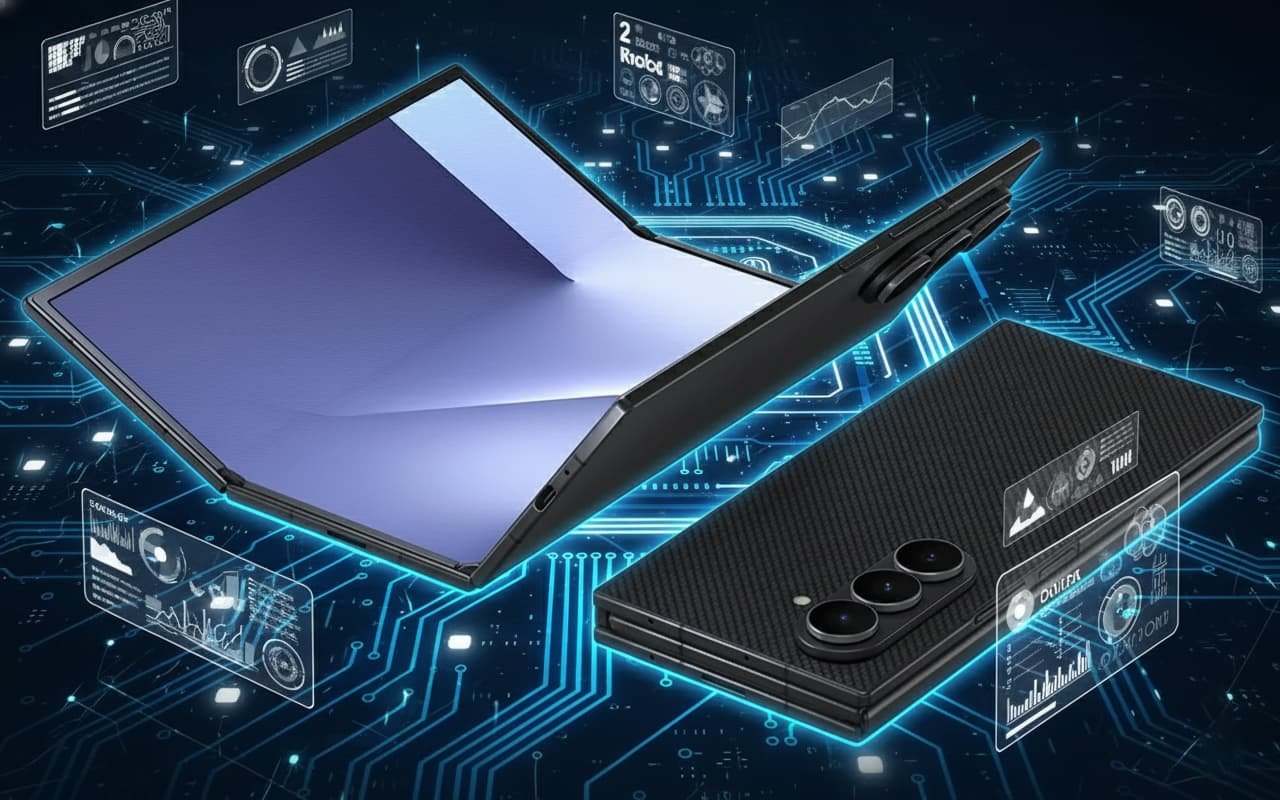
Samsung’s Galaxy Z Trifold arrives as one of the boldest foldable designs to date — a phone that unfolds not once, but twice. Out of the box it feels premium, arriving in a larger package than typical phones and including a slim case, USB-C cable, and a 45W charger. The device looks similar to the Galaxy Z Fold 7 from the front, featuring a 6.5-inch cover screen, but the moment you turn it around, the extra thickness becomes obvious. Weighing 309 grams, it’s nearly 50% heavier than most foldables, making it impossible to mistake for a normal phone when folded.
Opening the device happens in two stages: first pulling out the initial segment, then unfolding the second panel to reveal a full 10-inch display. Samsung added smart touches to make this motion easier, including a slightly extended rear panel to help you grip the top layers and a hidden magnet that gently lifts the middle screen for easier unfolding. When fully open, the device locks flat and feels surprisingly sturdy for something only 3.9 mm thick at its slimmest point.
However, the ambitious design does introduce challenges. The inner display now has two noticeable crease lines that catch light easily. Fingerprints accumulate on nearly every surface due to the glossy fiberglass composite finish, and the inner screen protector is delicate enough to scratch from simple contact with household objects. Foldables are already high-maintenance devices, and this model requires even more care.
The highlight of the Trifold is the 10-inch, 16:11 aspect-ratio display. This isn’t just a larger version of a typical foldable screen — Samsung has optimized apps to behave like true tablet interfaces. File management allows deeper navigation without losing context. The Gallery app uses the wider space to show more thumbnails, and Samsung Health displays dramatically more information at once. YouTube also feels upgraded, showing video, comments, and recommendations without shrinking the playback window.
Because the unfolded screen is more rectangular than square, widescreen video gains a major advantage. The content appears up to 50% larger than on typical bifold phones while reducing black bars at the top and bottom. The display is not the brightest, peaking at 1,600 nits compared to the Z Fold 7’s 2,600 nits, but for most daily use it remains vibrant and immersive.
The Trifold’s ability to rotate between landscape and portrait also adds flexibility, allowing users to browse, read, or doom-scroll in whichever orientation feels natural.

Samsung powers the Trifold with the Snapdragon 8 Elite chipset, still high-end but not the newest Elite Gen 5 appearing in some 2025 phones. Paired with 16GB of RAM and 512GB of fast storage, performance remains sharp, especially when multitasking. The large screen turns gaming into a mini-tablet experience, delivering rich visuals and strong frame rates.
Cameras remain identical to the Galaxy Z Fold 7 — a sharp 200MP main camera, but average secondary lenses, including a 10MP 3× zoom and a 12MP ultrawide. The folding design does bring advantages: using the rear camera for selfies, showing subjects a preview of themselves, and viewing recent shots while shooting. Still, there is no special camera upgrade exclusive to the Trifold format.
Battery capacity gets a meaningful jump to 5,600 mAh, distributed across three cells. Despite the thin design, Samsung includes 45W wired charging and 15W wireless charging. IP48 water-and-dust resistance matches the Z Fold 7 — decent for a foldable, though not on par with standard slab phones.
This is the first Samsung phone where Samsung DeX feels fully at home. The 10-inch display is large enough to serve as its own monitor, turning the phone into a mini desktop experience. Apps open in floating windows that can be moved, resized, or arranged across multiple virtual desktops. With a keyboard and mouse, the Trifold transforms into a compact productivity setup that fits in a pocket.
It isn’t identical to using a laptop — intensive apps pause when not in focus — but for office tasks, emailing, light editing, and browsing, it feels surprisingly natural.
Beyond DeX, Samsung’s multitasking on the large display is one of the best implementations on any phone. Users can run three apps side-by-side, swap their positions instantly, and save favorite combinations as “trios.” These open with a single tap and remember their layout, creating a workflow experience no bar phone can match.
The Trifold excels in functionality but demands careful handling. Six surfaces to smudge, a soft inner-screen protector that marks easily, and a heavy frame that clunks against tables make it less carefree than a standard phone. The included case helps stability, especially when tapping near the camera bump, but the device remains high-maintenance by nature.
Despite these issues, the software experience is polished. Apps scale intelligently, animations remain fluid, and Samsung’s existing decade of tablet optimization pays off. The combination of tablet-sized space and pocketable convenience is genuinely useful, not a gimmick.
The Samsung Galaxy Z Trifold is not meant for everyone. With a converted price around $2,400 in Korea — likely $3,000 in the U.S. once launched — it sits far above even premium foldables. This cost, combined with the delicate nature of triple-fold displays, means it requires commitment.
But for users who value multitasking, content consumption, productivity, and tablet-level screen area in a device that still fits in a pocket, the Trifold delivers an experience no other Samsung phone currently matches. Samsung’s years of foldable and tablet experience converge here into a polished first-generation design that already feels mature.
The Galaxy Z Trifold may not replace traditional phones for most people, but as Samsung’s most versatile foldable to date, it confidently sets a new direction for the future of mobile devices.