Breaking News
Popular News


Enter your email address below and subscribe to our newsletter
Smart Discovery Store
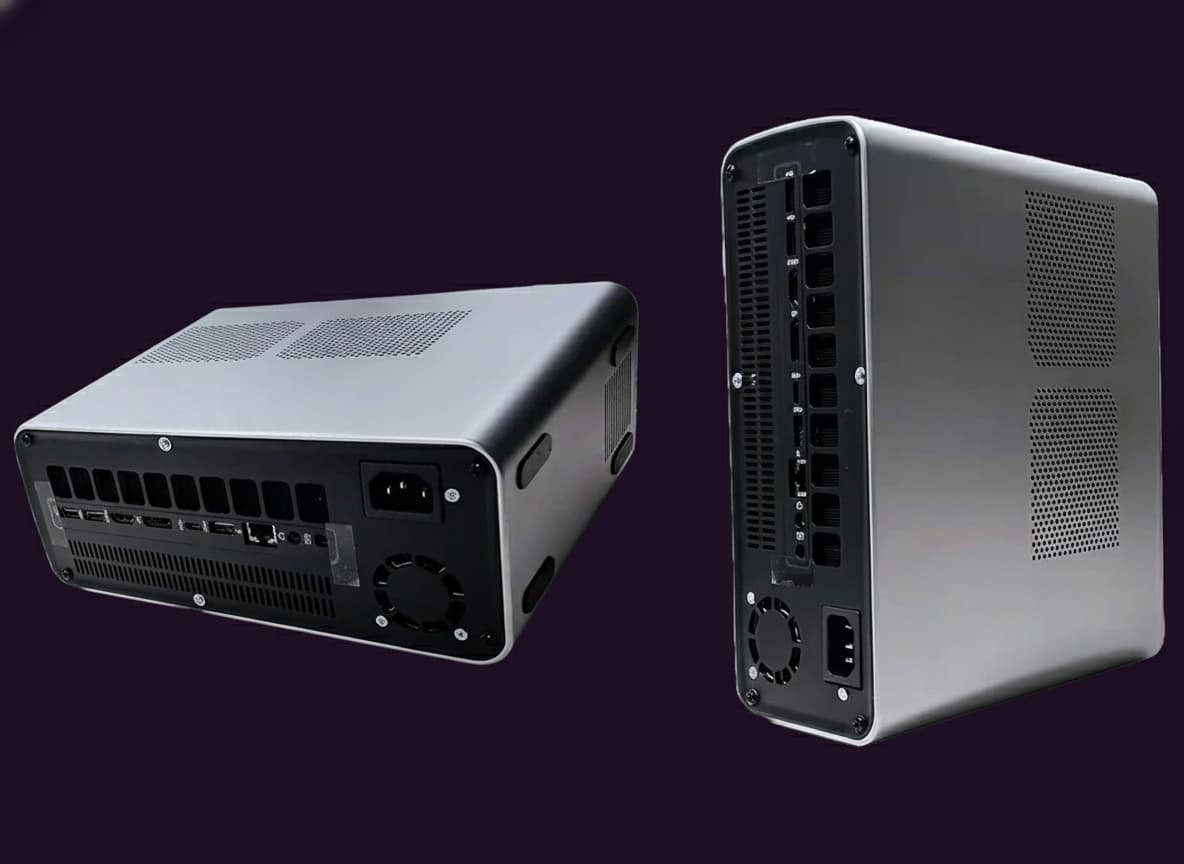
The AI Max 395+ Mini PC arrives with the kind of presence normally reserved for full desktops. Compact, metal, and built like a premium workstation, it brings together unified memory, a high-efficiency cooling system, and a powerful Ryzen AI 395+ chip that pushes the boundaries of what small form factor PCs can do. For creators, AI users, engineers, developers, and anyone who wants real power without a tower, this machine sets a new benchmark. Strong connectivity, internal PSU, and upgrade options make it stand out from every other mini PC in this class.
Its specs immediately raise eyebrows—128GB of unified RAM, multiple USB4 ports, dual 10GbE networking, and a cooling system designed to run sustained loads. There isn’t much fluff here. Everything exists for performance. And unlike many compact systems with external power bricks, this one integrates a 320W PSU directly inside the chassis for cleaner setups and better stability.
The exterior is all metal, clean, and minimal. Side and top vents pull in cool air while the rear exhaust pushes heat out through a dense fin structure. The bottom includes adjustable feet that allow horizontal or vertical orientation. Removing the shell reveals an organized and accessible layout: two M.2 NVMe slots, a removable Wi-Fi/Bluetooth module, and an internal PSU that helps power high-demand accessories.
This PC even includes a PCIe slot for expansion, though it cannot use GPUs. It’s meant for high-speed network cards or storage accelerators. The idea is clear: all computational power is handled by the AI-focused system-on-chip, while expansion focuses on connectivity. The chassis feels engineered rather than assembled—tight tolerances, clean cable routing, and airflow designed around performance rather than aesthetics.
The 395+ is not a normal CPU. It merges CPU cores, GPU compute blocks, RAM, cache, and NPU into a single high-bandwidth system-on-chip. This dramatically reduces latency and creates one large memory pool shared across all components. Instead of being limited by small VRAM or bandwidth bottlenecks, the integrated GPU can tap directly into massive memory availability—up to 128GB.
This approach mirrors what Apple did with the M-series: all components live inside the same physical architecture. The benefit is speed, efficiency, and the ability to handle large workloads without hitting memory ceilings. The drawback is upgradeability. RAM cannot be added later, GPU cannot be replaced, and the system behaves more like a sealed performance module. But for AI workloads, 3D work, creative processing, and LLM tasks, unified memory is a major advantage.
Performance testing shows the 395+ pushing Cinebench scores around 1800–1900 in performance mode, matching desktop-class processors like the 14900K—but with much less power consumption and far lower noise. Sustained workloads hold steady at 60–65°C with minimal fan noise. Boost clocks frequently hit 4.8GHz before dropping to stable ranges.
AI testing shows significant gains once GPU memory allocation is increased in BIOS. Large models load directly into unified RAM, and token generation speeds rise dramatically using Vulkan acceleration. With proper configuration, this system handles 20B–120B parameter models with speeds that put many laptops and desktops to shame. For development teams, AI labs, or creators working with heavy compute pipelines, this is a major shift in capability.
The back panel features an unusually strong port layout: three USB4 ports (two at 80Gbps and one at 40Gbps), dual 10GbE ports, HDMI, USB-A, and the PSU connector. This combination supports high-speed networks, external NVMe enclosures, Thunderbolt displays, and multi-device creative workflows. Unlike many mini PCs, this one feels ready for a studio environment, not just a home office.
Wi-Fi and Bluetooth are on removable modules, storage slots are easy to access, and the internal PSU keeps desk clutter minimal. For remote editors, AI researchers, and professionals who travel with powerful setups, this machine replaces the need for large desktops entirely.
The AI Max 395+ is not just another mini PC. It’s one of the most complete and forward-thinking compact workstations available in 2025. Unified memory gives the integrated GPU enormous strength. The cooling system handles sustained loads quietly. Connectivity is beyond what most laptops or desktops offer. And the internal power supply makes it feel like a premium, all-in-one performance block.
Any creator or AI developer needing raw compute power in a small footprint will find this machine unmatched. With its speed, stability, and expandability through network and USB4 devices, the AI Max 395+ stands as one of the best small form factor systems available today.