Breaking News




Popular News





Enter your email address below and subscribe to our newsletter
Smart Discovery Store
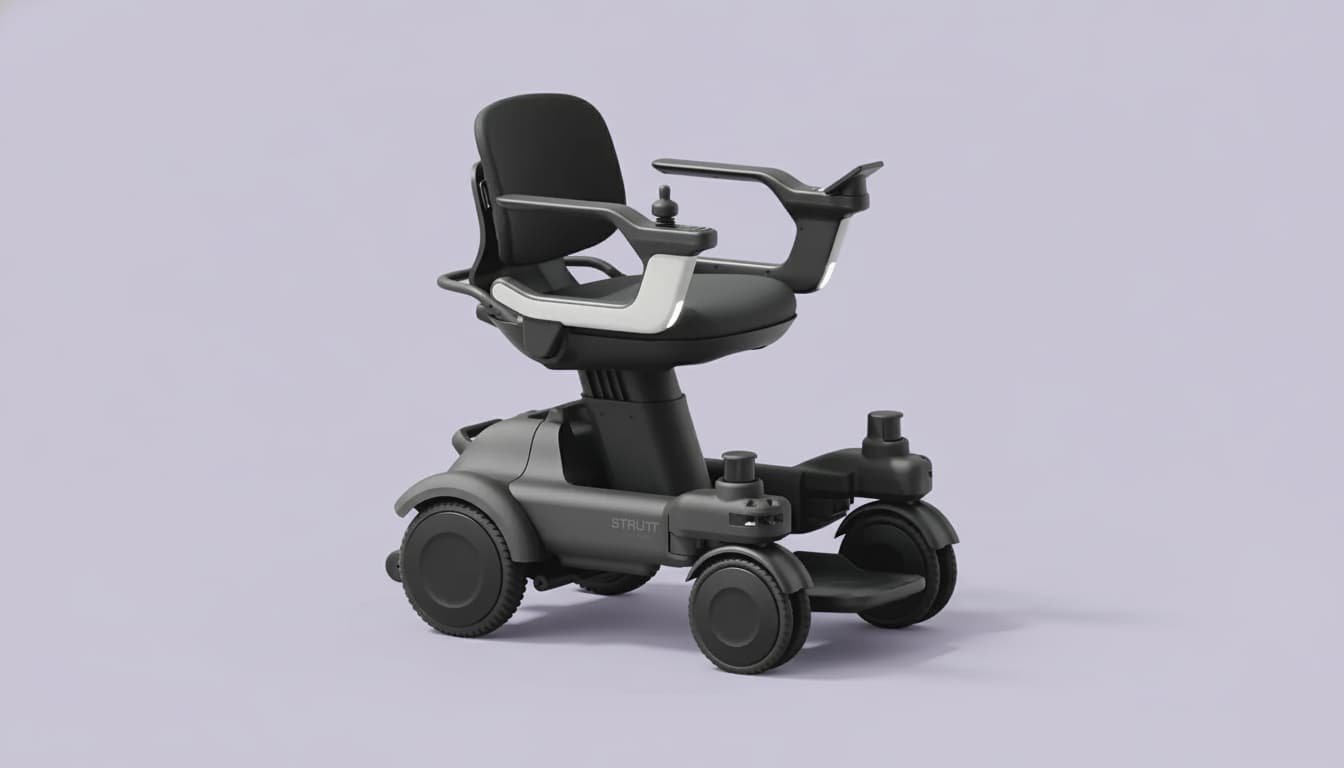
The Strut EV1 represents a fundamental shift away from traditional electric wheelchairs toward a new class of autonomous mobility robots. Rather than simply motorizing a chair, the EV1 integrates robotics, sensor fusion, and AI navigation to create a device that actively perceives and responds to its environment. This approach transforms mobility assistance into a sophisticated, adaptable transport system capable of navigating indoors and outdoors with precision. The device blends elements of humanoid robotics and autonomous vehicle technology, offering users a level of capability previously unavailable in personal mobility equipment.
At the core of the EV1 is an array of advanced sensors: LiDAR, cameras, ultrasonic modules, and additional perception hardware that collectively map the surrounding space. This multi-sensor configuration enables the EV1 to perform autonomous routing, obstacle detection, and collision avoidance in real time. Users can simply issue natural language commands—such as requesting to go to the refrigerator—and the system will plan and execute the route independently.
This capability is especially impactful for navigating homes and buildings that are not optimized for accessibility. Traditional mobility devices require continuous user input and careful steering to avoid doorframes, furniture, and structural constraints. The EV1 removes that burden, allowing hands-free travel through tight indoor environments. Outdoors, the EV1 continues to perform reliably, adjusting to terrain variations, gaps, rails, and uneven surfaces while maintaining stability and control.
Strut engineered several distinctive features to extend usability beyond smooth indoor floors. The EV1 incorporates a suspension system designed for real-world bumps and transitions. Dual front wheels—mounted as powered units rather than passive casters—provide enhanced steering authority and improved handling over gaps such as trolley rails or sidewalk expansions.
Each of the front wheels includes its own motor, giving the EV1 power steering and smoother directional control compared to tank-steer mobility devices. This approach reduces friction, cutting down on the force required to turn and enabling more precise maneuvering at various speeds.
Portability is another major highlight. The entire EV1 can be disassembled into five main components in about 30 seconds, without tools or cables to disconnect. Each piece is sized and weighted for placement in a car trunk, making transport far more practical than conventional powered wheelchairs, which often require ramps or dedicated carriers.
Strut’s Co-Pilot mode demonstrates the strength of the EV1’s autonomy. Instead of fully taking over control, the system works alongside the user—similar to advanced driver assistance in modern automobiles. Users maintain directional input, but if a collision is imminent, the EV1 intervenes to adjust acceleration, braking, or steering to avoid impact.
Tests show the EV1 navigating curved pathways with a blindfolded user issuing only forward input. The device automatically adjusts its trajectory to remain within the safe path, highlighting the precision of its environment mapping. Additional tests revealed its ability to halt gently before encountering obstacles even when driven at full speed toward barriers.
This safety intelligence is equally beneficial for preventing accidental harm to pets, objects, or walls in crowded indoor environments. By constantly monitoring surroundings and calculating safe motion vectors, the EV1 reduces the cognitive demand on users and minimizes the damage that can arise from everyday navigation challenges.
The EV1 is engineered for agility and stability, achieving software-limited speeds of around 12 km/h (approximately 7.5 mph). Even at maximum velocity, steering remains smooth and predictable. Maneuverability on diverse surface types—including pavement, stone, compact soil, and slopes—is impressive, thanks to the multi-wheel drive configuration and suspension system.
Testing sessions showcased how well the system adapts to obstacles that rarely receive consideration in wheelchair design, such as unexpected drop-offs or transition edges. The EV1’s autonomous behaviors allowed it to handle these situations with surprising fluidity.
In manual mode, the EV1 offers a more traditional driving experience, maintaining stability while allowing users to explore its performance envelope. Its balance of speed and control becomes particularly evident in competitive demonstrations, where acceleration and directional consistency are clear strengths.
Beyond the engineering accomplishments, the EV1 serves as a reminder of the challenges individuals face when navigating environments not designed with accessibility in mind. Its autonomy offers meaningful relief from daily physical and mental strain. The device’s ability to make mobility fun is an unexpected but welcome development—blending functionality with an enjoyable, confidence-building experience.
Users who do not currently require mobility assistance can still appreciate the broader implications: aging populations, recovery scenarios, and unexpected life events create future needs. Technology that elevates dignity, independence, and safety holds deep societal value, and the EV1 demonstrates that assistive robotics can be empowering without feeling clinical or restrictive.
Strut has not yet announced final pricing. Considering that even basic electric wheelchairs often exceed several thousand dollars, early models of advanced autonomous systems are unlikely to fall into a low-cost range. However, early-bird reservations for the first 200 units include a 35% discount. The company plans to reveal official pricing early next year.
Like any emerging technology—especially one combining robotics, autonomy, and modular engineering—initial costs will reflect early-stage development. Over time, economies of scale and broader adoption may help reduce pricing, making devices like the EV1 more accessible. As the first generation of a new mobility platform, the EV1 sets the foundation for future iterations that are likely to become more affordable and widely available.