Breaking News


Popular News


Enter your email address below and subscribe to our newsletter
Smart Discovery Store
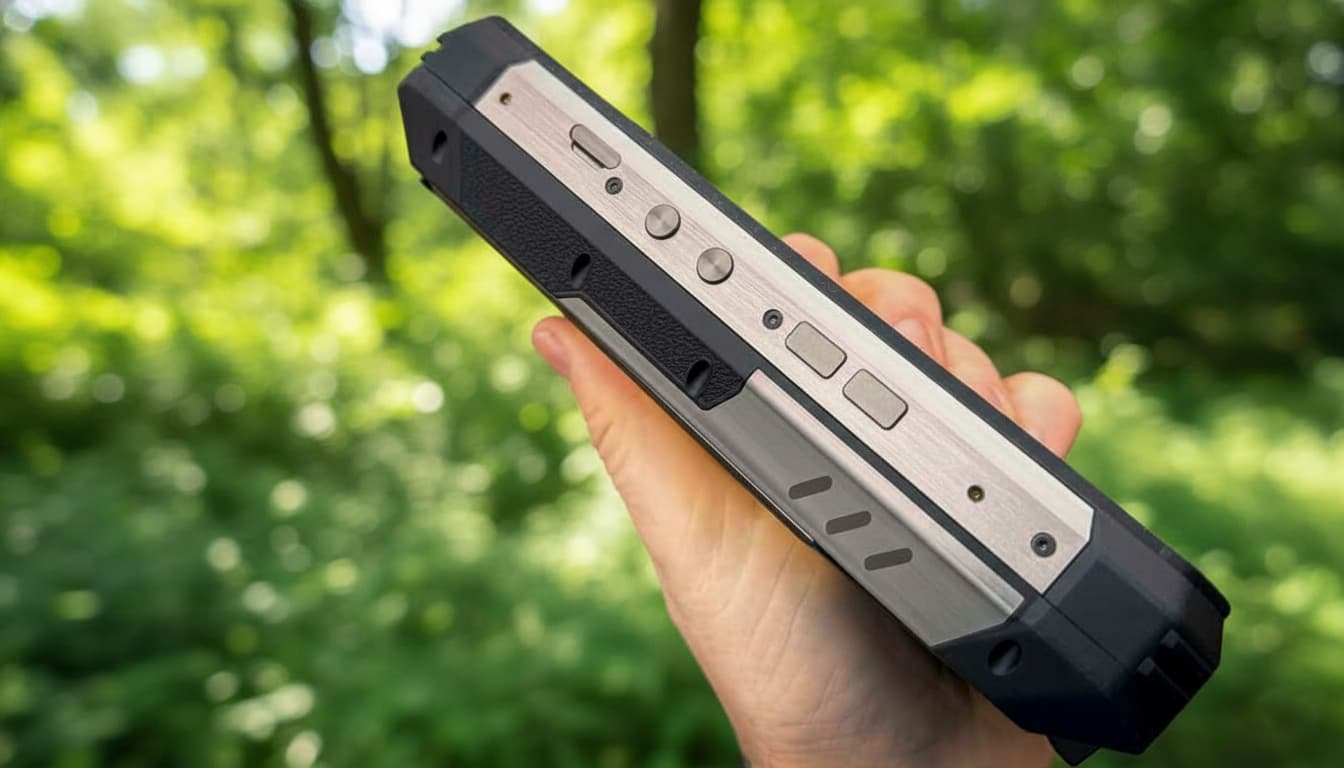
The Ulefone WP100 Titan doesn’t try to fit into the normal smartphone world. It doesn’t care about slim bezels, lightweight frames, or pocket-friendly curves. It’s the kind of device you pack beside a multi-tool and a flashlight, not beside a MacBook. With a monstrous 33,000 mAh battery, an integrated 100-lumen projector, and a 12,200-lumen camp light that can run longer than some generators, it feels less like a phone and more like a survival appliance. From the first moment you pick it up, it’s clear this thing wasn’t built for scrolling Instagram—it was built for someone who spends more time off the grid than on Wi-Fi. It’s thick, unapologetically industrial, and so heavy that you instinctively brace your wrist before lifting it. But that’s the point. The Titan isn’t pretending to be a sleek flagship. It’s a slab of utility, wrapped in metal, rubber, and overbuilt hardware designed to get thrown, dropped, soaked, frozen, and still last another week.
The Battery That Redefines “All Day”
The number that makes everything about the Titan make sense is 33,000 mAh. That’s not a typo. That’s not a marketing exaggeration. That is a battery larger than some portable power banks—inside a phone. Ulefone claims six months of standby, two full weeks of normal use, over 45 hours of video playback, and 20+ hours of nonstop camp light illumination. And based on weight alone, you believe them. This thing could power a campsite, a long photography trip, or an entire weekend outdoors without even thinking about a charger. But big batteries come with big drawbacks: it takes four hours to recharge fully, even with the included 66W charger. And other third-party chargers behave unpredictably, sometimes not even completing a charge cycle. Still, for the target audience—contractors, hikers, off-grid explorers—that tradeoff is acceptable. You charge it before a trip, and you don’t think about power again until you’re back home.
A Projector, a Floodlight, and More Tools Than a Phone Should Have
The Titan comes packed with hardware features no mainstream phone would ever attempt. The 100-lumen projector is the headline gimmick, but it works surprisingly well. Auto-keystone kicks in instantly, image adjustments respond quickly, and despite the 854×480 resolution, you can throw a movie onto a tent wall and actually enjoy it. Ventilation grills hum softly when the projector is on—another reminder that this phone isn’t just a phone. Then there’s the 12,200-lumen LED camp light. It’s shockingly bright. At max power it can light up a field, a worksite, or a trail in pitch-black night. It’s warm, it’s intense, and it genuinely replaces a real lantern. The Titan also includes an underwater camera mode, programmable side keys, NFC, and both IP68 water resistance and MIL-STD-810H durability. It’s not pretending. This thing is built to survive the kind of environments where a normal smartphone becomes a cautionary tale.
The Compromises Nobody Should Ignore
For all its extreme strengths, the Titan has extreme weaknesses. The camera system—200MP main sensor, 20MP night sensor, 2MP macro—sounds impressive on paper but immediately disappoints. Shutter lag, poor dynamic range, and oversaturated tones make it more of a documentation tool than anything resembling a flagship shooter. The 32MP selfie camera is equally rough, delivering soft, inconsistent results. Audio is even worse; the single speaker is tinny, flat, and barely loud enough for outdoor use. The MediaTek processor is serviceable but feels sluggish compared to modern premium chips, performing at roughly a third of the speed of a Galaxy S25. And then there’s the size. At nearly one kilogram, the Titan might be “pocketable” in the technical sense, but anyone trying to walk with it in their jeans will feel like they’re smuggling a brick. This is a two-hand device. It will not disappear into a pocket, a purse, or a coat. It demands space, strength, and the kind of person who actually needs the power it provides.
Who Is This Monster Phone Actually For?
The Titan is not for everyday users. It’s not for people who want the latest camera tricks or silky UI animations. It’s not for people who spend their days bouncing between coffee shops with a laptop bag. It’s for people who work in dust, mud, rain, construction sites, and remote wilderness. It’s for campers who stay off-grid for days. It’s for field technicians, surveyors, travelers, and explorers who cannot afford their device dying in the middle of a job or a journey. And for that audience, you can understand why this thing costs $800–$900. You’re buying a battery, a lantern, a projector, a rugged shell, and a phone in one package. It replaces a handful of tools you’d otherwise carry separately. And that’s the Titan’s real pitch: not being a great phone, but being an all-in-one survival companion. For everyone else, a normal smartphone and a battery bank make far more sense. But for the people it’s built for, this might be the one device that actually fits their real-world needs—even if it weighs as much as three stacked iPhones and looks like a weapon.