Breaking News


Popular News



Enter your email address below and subscribe to our newsletter
Smart Discovery Store
Valve has announced an entire lineup of new hardware, but the standout reveal isn’t the VR headset or refreshed controller—it’s the upcoming Steam Machine, a compact living-room gaming PC powered by SteamOS. While users can already install SteamOS on their own hardware, this marks the first time since the early Steam Machine era that Valve is releasing an official, purpose-built device for televisions and home entertainment setups. The combination of a semi-custom AMD processor, RDNA 3 graphics, and Steam Deck-style software design signals that Valve is aiming to deliver console-like simplicity with PC-grade flexibility.
Pricing remains undisclosed, but Valve has clarified that it will not target console pricing. Instead, the Steam Machine will sit within entry-level gaming PC territory. Current market conditions suggest a broad range, likely between $799 and $1,350 depending on configurations, storage options, and regional availability. Valve’s emphasis on 4K gaming through FSR indicates a strong focus on performance per watt and visual scaling rather than brute-force hardware.
One of Valve’s primary goals with this system is to bring the streamlined Steam Deck experience to the living room. SteamOS offers near-instant suspend and resume, seamless updates, built-in controller support, and direct access to the full Steam library. Desktop Mode provides a familiar Linux environment for productivity or additional applications, while Remote Play, cloud saves, and the Steam social ecosystem are integrated by default.
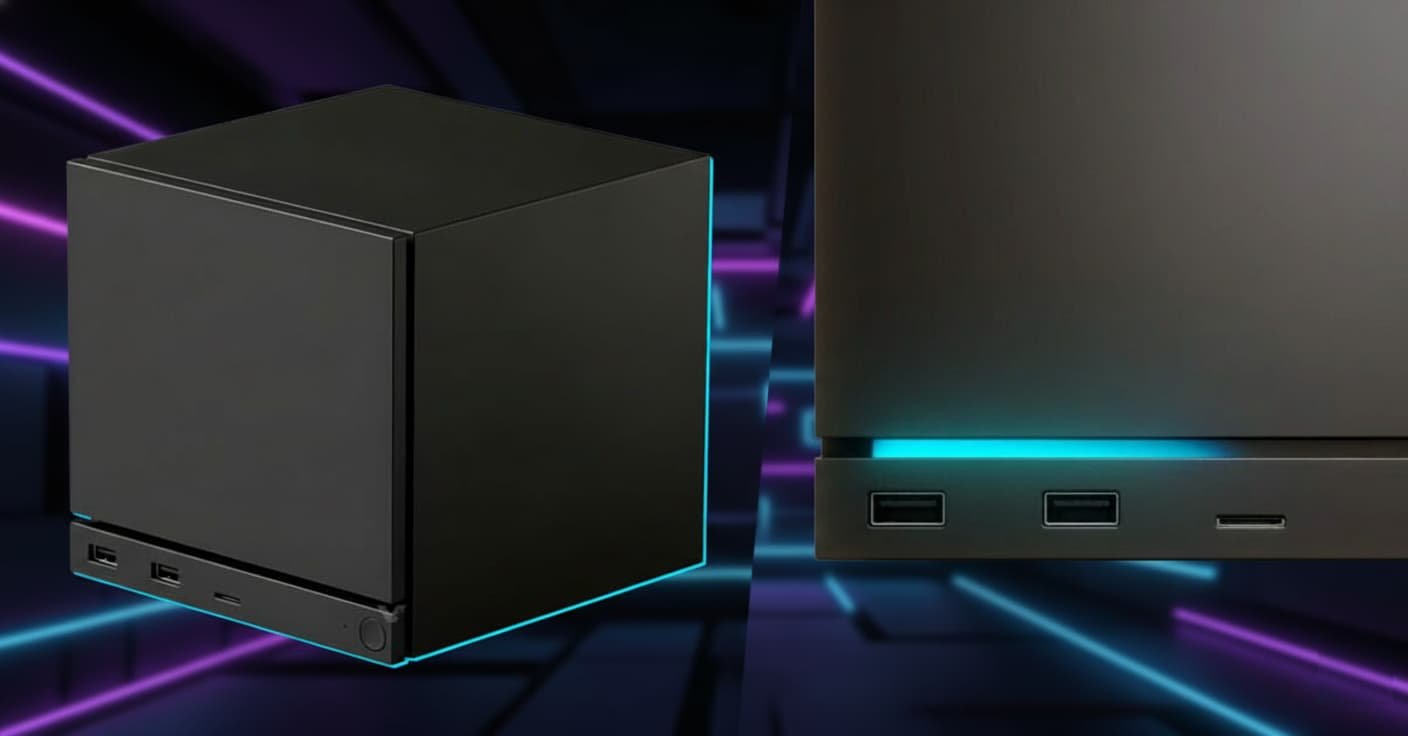
The Steam Machine includes a customizable RGB light bar on the front that acts not only as decoration but also as a functional indicator—signaling notifications, download progress, or system states. Valve appears to be extending the polished user experience of the Steam Deck into a device that prioritizes living-room immersion without sacrificing PC versatility.
The Steam Machine adopts a compact, quiet chassis designed for entertainment centers. The power supply is built into the unit itself, eliminating the need for an external brick. Ports are distributed logically between the front and the rear, allowing easy access for controllers, storage, or VR peripherals.
Front I/O includes two USB 3.2 Gen 1 ports, a microSD card slot, and the power button. The rear houses DisplayPort, HDMI, USB-C, power input, and two USB 2.0 ports for accessories. The layout ensures that users can maintain a clean setup while still connecting external drives, keyboards, or multiple displays. The device aims to satisfy anyone who wants PC-level capability in a more consumer-friendly form factor.
The microSD slot mirrors the convenience of the Steam Deck, offering simple library expansion without requiring internal disassembly. Valve’s goal is clear: a plug-and-play PC gaming experience designed for accessibility and ease of use.
Valve’s semi-custom AMD APU is built around a Zen 4 CPU with six cores and twelve threads, boosting up to 4.8 GHz while remaining within a 30-watt TDP envelope. This balance of efficiency and performance is key to keeping heat, noise, and power consumption under control inside a compact enclosure.
The integrated GPU is a custom RDNA 3 design with 28 compute units and a sustained 2.45 GHz clock. Equipped with 8 GB of dedicated GDDR6 VRAM and a 110-watt total graphics power, the chip resembles the popular Radeon 760M found in laptops and handhelds, though it may include custom tuning for SteamOS.
Together, the CPU and GPU position the Steam Machine well above Steam Deck performance while avoiding the thermal constraints of handheld hardware. Valve is targeting 4K 60fps using FSR—something this RDNA 3 configuration is well suited for, especially at medium-high settings. The real-world performance will likely rival mid-tier PCs optimized for living room gaming rather than ultra-high-end rigs.
Valve’s claim of 4K 60fps capability hinges on the efficiency of AMD’s upscaling technologies. FidelityFX Super Resolution allows the GPU to render at a lower internal resolution and reconstruct the image, providing visually stable output while maintaining higher frame rates. In combination with SteamOS optimizations and Vulkan-based graphics paths, the Steam Machine should deliver an experience closer to a dedicated console than a traditional PC.
Fast suspend and resume, seamless system updates, Steam Input configurability, and Big Picture Mode are central to the platform. Users can launch directly into games without navigating Windows settings or background processes. The system also supports desktop mode for those who want the full Linux environment for productivity or experimentation.
Valve’s approach is clear: make PC gaming simple, powerful, and approachable for anyone who prefers the living room experience.
The upcoming Steam Machine appeals to several key groups. Gamers who loved the Steam Deck but want more power on a larger display will find it familiar and accessible. Living room gamers who don’t want to assemble or maintain a Windows PC will benefit from SteamOS simplicity. Linux enthusiasts will view it as the cleanest official hardware platform for running Valve’s ecosystem.
On the other hand, users who prefer full Windows compatibility, highest-end graphical performance, or custom hardware builds may prefer assembling their own small-form-factor PC. Valve itself acknowledges this option, but the Steam Machine’s value lies in its integration, consistency, and ease of use.
With the right price, this device has strong potential to become a mainstream living-room gaming solution—especially when paired with Valve’s new Steam Controller refresh.
Valve estimates an early 2026 release window. While this leaves many details unconfirmed—final pricing, storage tiers, cooling noise levels—enthusiasm is already growing. If Valve positions the Steam Machine competitively, it could fill the long-standing gap between handheld Steam experiences and full-size desktop gaming.
The seamless blend of a tuned Zen 4 APU, RDNA 3 graphics, SteamOS optimizations, and console-like features may deliver one of the most accessible PC gaming devices ever released. As more information becomes available and early units enter the market, performance testing will reveal the true potential of this compact gaming platform.